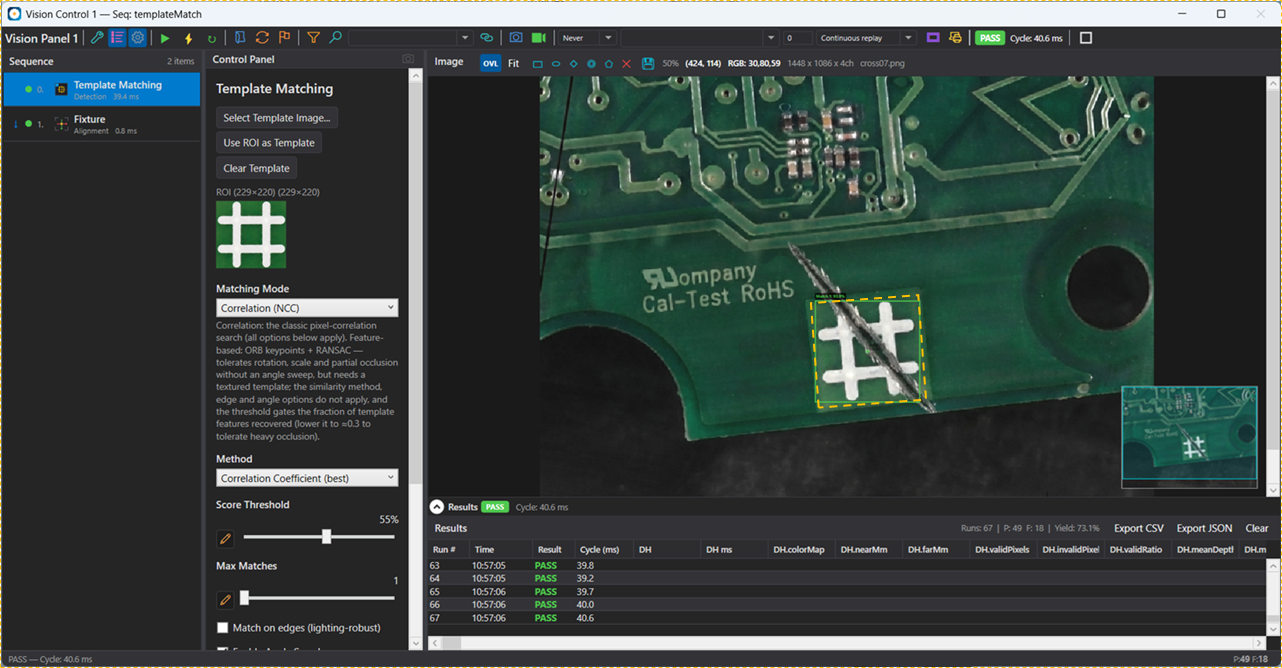
Template Matching — correlation and feature-based (ORB + RANSAC) search locates a taught pattern under rotation, scale, and partial occlusion, gated by a score threshold.
VisionBase Studio covers acquisition, processing, decision, communication, and reporting. Inspections are built from 47 vision components across eight categories, and the application runs on Windows and Linux. The sections below list the available capabilities.
Each tool is a step in the pipeline. Components are packaged as plugins, so the set can be extended.
Condition the image before detection: convert, threshold, filter, mask, and remap.
Locate features, codes, text, and defects.
Produce dimensions, gauges, and pass/fail verdicts in real-world units.
Align the inspection to a moving part, and add logic and derived values.
Template Matching — correlation and feature-based (ORB + RANSAC) search locates a taught pattern under rotation, scale, and partial occlusion, gated by a score threshold.
ONNX inference runs in the pipeline with DirectML GPU acceleration. Labelling, augmentation, and training are available within the application, so a separate machine-learning service is not required.
Model input size and layout (NCHW/NHWC) are detected automatically. CPU fallback is used when no GPU is available.
Collect, label, and augment images from the line; train detection, classification, or segmentation models; export to ONNX. Training can run offline.
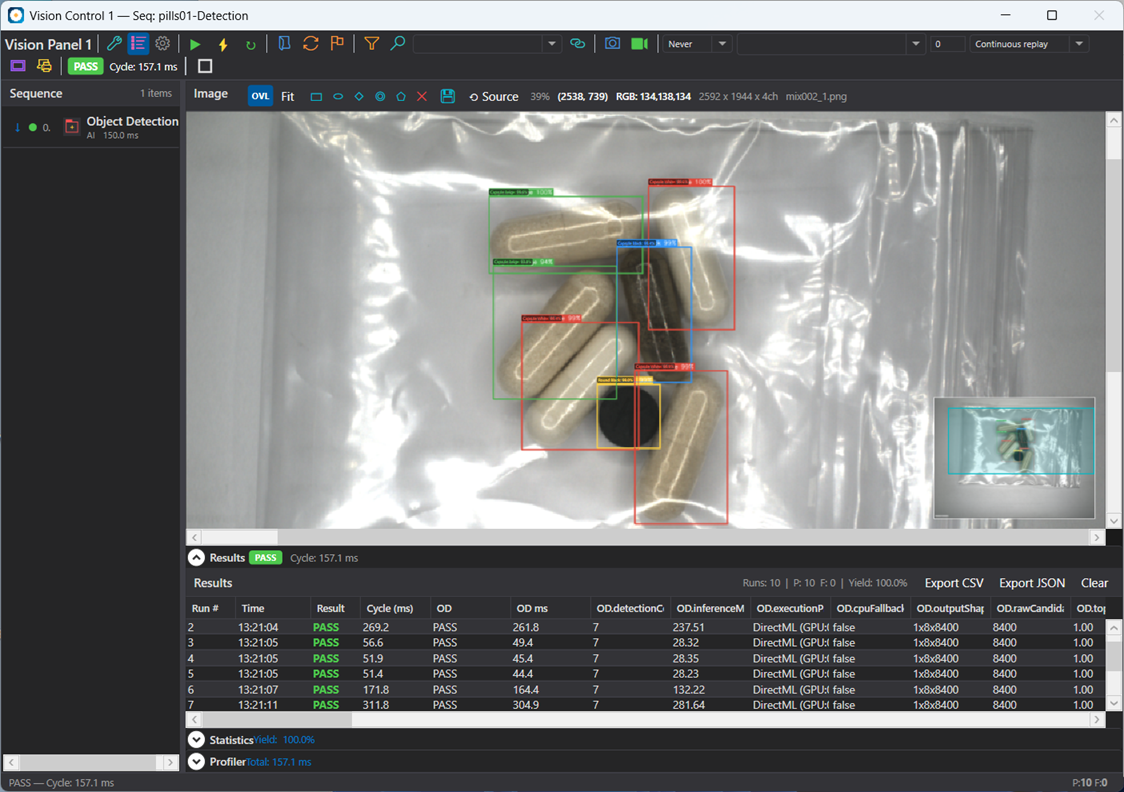
Object Detection — a trained model locates and classifies multiple parts per frame, running on DirectML GPU acceleration with full per-run result logging.
Process 16-bit depth maps for height, flatness, and volume checks.
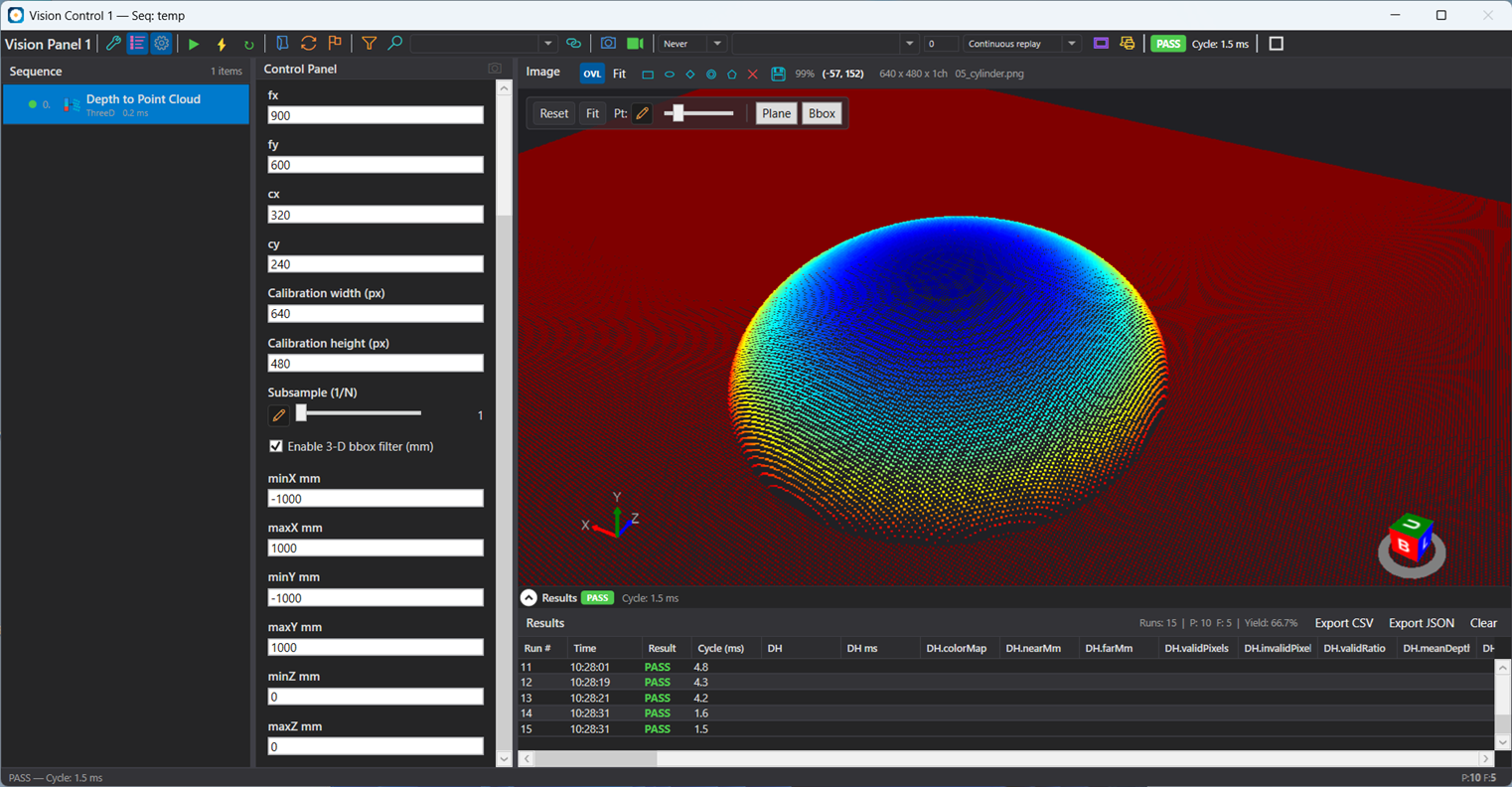
Depth → Point Cloud — converts a 16-bit depth map into a calibrated 3D point cloud using camera intrinsics, with interactive rotation, plane/bbox tools, and metric filtering.
An in-app AI copilot plus a Model Context Protocol server that gives external AI agents the same disciplined control surface. The model only ever proposes; the station validates, caps, and executes deterministically.
A JSON-RPC 2.0 server over Streamable HTTP exposes 21 tools to external agents (Claude and others) — run inspections, sweep and collect, snap/live, get status, sequence and parameters, set parameters, read results, images, and statistics, load sequences and recipes, and search the docs.
Optional bearer token (required for remote binding); guide retrieval runs locally and only chat text reaches the configured provider.
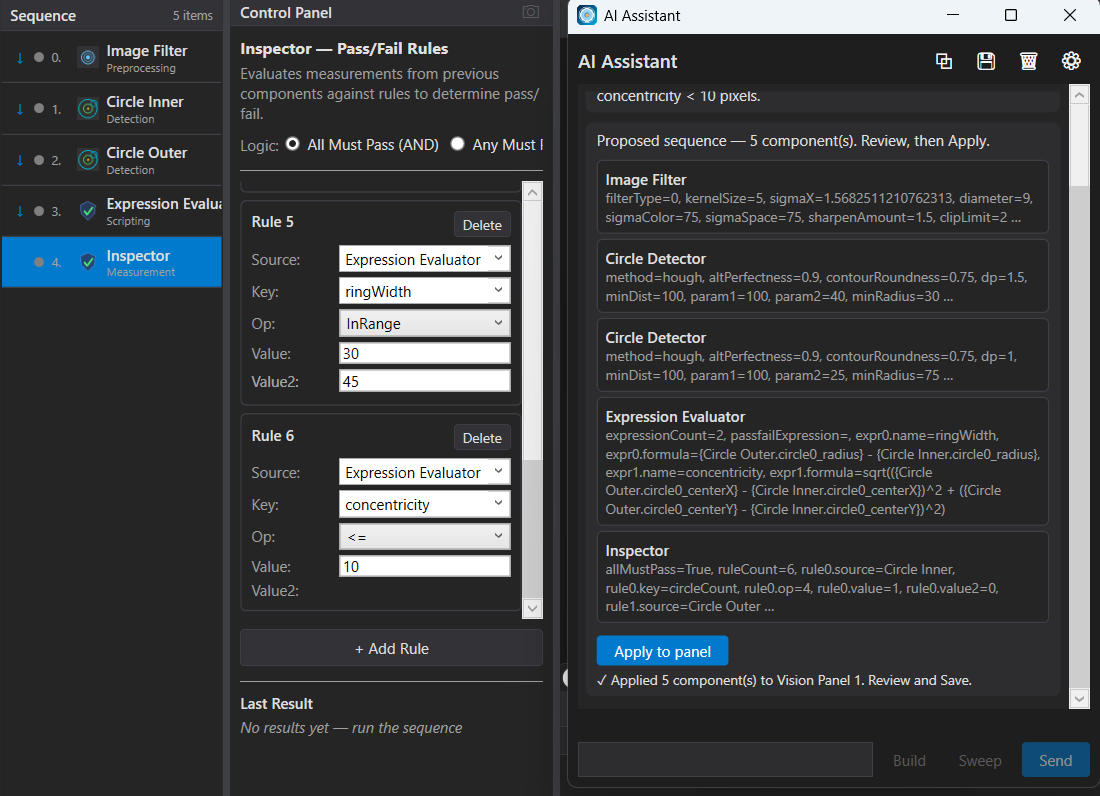
AI Assistant — Build — a plain-language request becomes a validated multi-component sequence with pass/fail rules, applied to the live panel behind an Engineer-gated single undo.
An input edge can trigger acquisition; pass, fail, busy, and ready outputs are written after each cycle.
Communication plugins accept LOAD_SEQUENCE and LOAD_RECIPE commands and return a structural-compatibility result, so a line controller can change the active inspection for the next product.
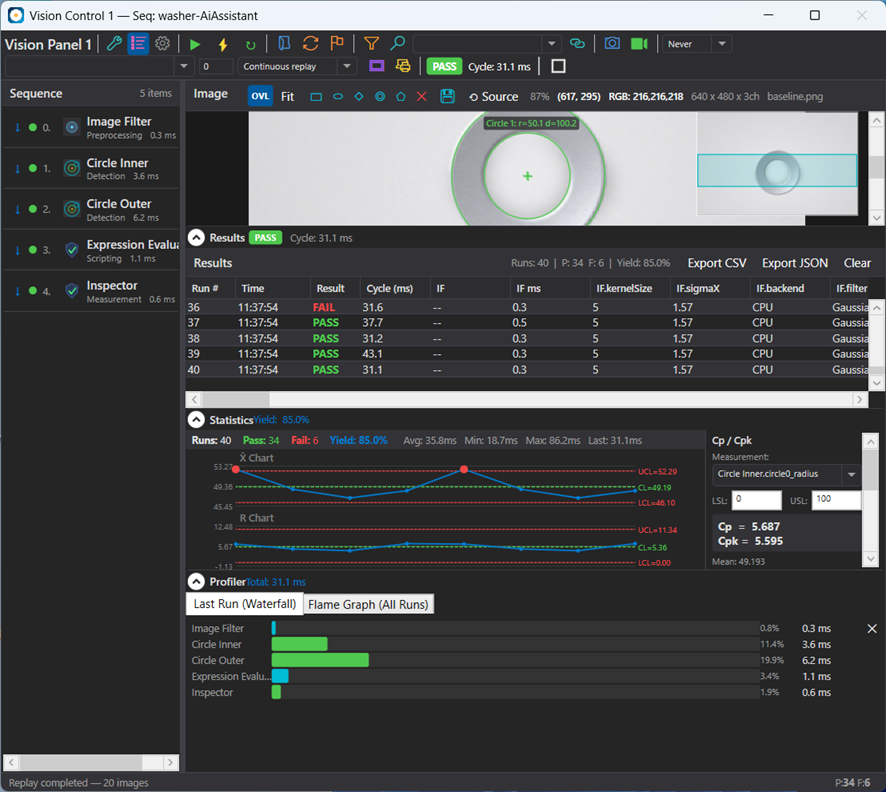
X-bar/R control charts (A2/D3/D4 constants), Cp/Cpk, and out-of-control detection.
Yield, cycle-time statistics, defect breakdown, and trend charts per station.
Operator, shift, batch, and serial captured from the barcode; daily audit logs.
Scheduled PDF reports (QuestPDF) and a web dashboard over HTTP and WebSocket.
Image logging (never, fail-only, or always), replay from a folder, and recent run-history snapshots.
Headless .vbtest suites assert measurements and pass/fail per image, for use in CI.
.deb, Raspberry Pi; en / zh / thDescribe the inspection and we can prepare a sequence from these components, with the camera, communication, and reporting configured.